
When importing frozen seafood, the product specification is only part of what buyers need to evaluate. Packaging, glazing, freezing method, net weight and labeling can all affect product quality, landed cost, storage, customs clearance and how easily the seafood can be distributed after arrival. Buyers who are new to international purchasing can also read our How to Import Frozen Seafood from Norway guide for a broader overview of the import process.
Frozen seafood is supplied in many different formats. Depending on the product, buyers may receive IQF seafood packed in polybags and master cartons, block-frozen products, vacuum-packed portions, glazed fillets, individually wrapped products or bulk cartons for further processing and foodservice distribution. Buyers who want more detail about individual quick freezing can read our What Is IQF Seafood? guide.
For importers and wholesale buyers, understanding these specifications is particularly important when comparing quotations. A 10 kg carton, for example, does not always mean 10 kg of actual seafood if the quoted weight includes glazing or packaging. Buyers should clearly establish whether prices and carton weights are based on net weight, gross weight or net weight excluding glaze.
Labeling is equally important. Export cartons typically need information that allows the product to be identified and traced, while individual destination markets may impose additional labeling and import requirements. Product name, species, size or grade, net weight, production information, storage conditions, lot identification and country of origin are among the details buyers may need to verify.
This guide explains the main frozen seafood packaging formats used in international trade, how glazing and IQF affect product specifications, what information to check on export cartons, and what importers should confirm with their supplier before placing a wholesale order. Buyers can also explore our frozen seafood products for available wholesale options.
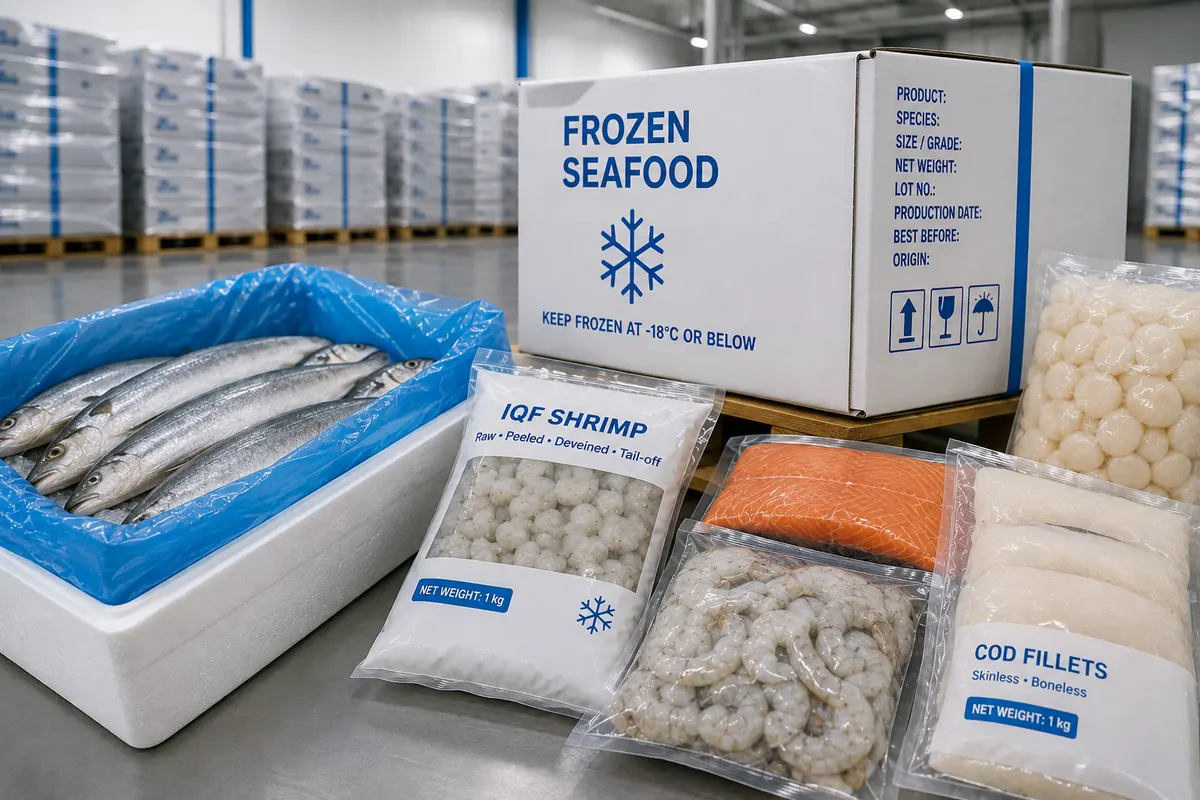
Packaging plays an important role in protecting frozen seafood throughout storage, handling and international transportation. For importers and distributors, however, packaging is also a commercial specification that can affect net product weight, freight calculations, storage requirements, product identification and the final landed cost.
Different frozen seafood products require different packing methods. Whole frozen fish, fillets, portions, shrimp, crab and other seafood products may be packed in cartons, food-grade polybags, vacuum packs, IQF bags or block-frozen formats depending on the product and buyer requirements.
One of the most important considerations is understanding exactly what quantity of seafood is being purchased. Two cartons may have the same gross weight but contain different net product weights because of packaging materials, glazing or other factors. Buyers should therefore compare quotations using the stated net weight, rather than relying only on carton weight or carton price.
Packaging also helps protect frozen seafood against physical damage, contamination and dehydration during transportation and storage. Suitable inner packaging and properly constructed export cartons are especially important when products will pass through multiple stages of handling before reaching the buyer's cold-storage facility.
For international shipments, packaging also supports traceability and regulatory compliance. Carton markings and labels can provide important information such as the product name, species, size or grade, country of origin, net weight, production or freezing information, lot identification and required storage conditions.
Importers should therefore confirm the complete packaging specification before an order is finalized. Packaging should be treated as part of the seafood specification itself—not simply as the box in which the product arrives.
Frozen seafood is packed in different formats depending on the species, product form, freezing method, shipment size and requirements of the buyer. Importers should confirm both the inner packaging and outer export packaging, because these determine how the product is protected, handled, stored and distributed after arrival.
Export cartons are commonly used as the outer packaging for frozen seafood. For example, our frozen Norwegian king crab legs are supplied in export cartons for international wholesale orders. Depending on the product, common net weights may include 5 kg, 10 kg, 20 kg or other buyer-agreed specifications. The seafood inside may be packed in polybags, vacuum packs, smaller inner cartons or other food-grade packaging.
Buyers should confirm the net weight, gross weight, carton dimensions, number of inner packs and packing configuration rather than assuming that all cartons of the same stated size contain the same quantity of product.
Polybags and plastic liners provide an additional protective layer between the seafood and the outer carton or insulated container. They are commonly used for whole fish, fillets, portions, shrimp and other frozen products.
For bulk products, a larger food-grade liner may be placed inside the master carton before the seafood is packed. Individually frozen products may instead be divided into smaller sealed bags according to the buyer's required pack size.
Individually Quick Frozen (IQF) products are often packed in sealed food-grade bags before being placed into master cartons. Buyers who want to understand the freezing process in more detail can read our What Is IQF Seafood? Benefits for Importers & Distributors guide.
This format is commonly used for products such as shrimp, fish portions, fillets and other individually frozen seafood. Pack sizes can vary according to wholesale, foodservice or retail requirements.
Here we can internally link IQF seafood to your existing What Is IQF Seafood? guide.
Vacuum packaging removes much of the air surrounding the seafood before the package is sealed. It is commonly used for products such as fish fillets, loins, portions and other value-added frozen seafood.
Wholesale buyers should confirm whether products are individually vacuum packed or whether several pieces are packed together, as this can affect portion control and distribution.
Some seafood is frozen together into blocks rather than as separate individual pieces. The frozen block may be protected with an inner liner or bag and then packed into a master carton.
Block freezing can be suitable for bulk distribution and processing applications, while IQF packaging generally provides greater flexibility when individual pieces need to be removed separately.
Importers supplying supermarkets or retail channels may require smaller consumer-ready packs rather than standard bulk export cartons. These can include branded or private-label bags, vacuum packs, trays or smaller cartons.
Requirements such as pack weight, label language, barcode, nutritional information and other mandatory declarations should be agreed before production and must comply with the rules of the destination market.
The outer master carton may still be used to consolidate these smaller retail units for international transportation.
Buyer Tip
Before confirming an order, request the supplier's complete packing specification showing the inner pack, master carton, net weight, gross weight and units per carton. This makes quotations from different suppliers much easier to compare accurately.
Glazing is commonly used on frozen seafood to help protect the product from dehydration, oxidation and surface damage during frozen storage. A thin layer of ice forms around the seafood, creating a protective barrier between the product and the surrounding air.
For wholesale buyers, however, the important issue is not simply whether a product is glazed. Importers need to understand how much glaze is applied and whether the quoted weight refers to the seafood itself or includes the glaze.
Glazing is created by applying water to the surface of already frozen seafood and allowing it to freeze into a protective ice coating. Depending on the product and processing method, this may be done by dipping or spraying the frozen seafood.
Glazing is commonly found on products such as frozen fish fillets, portions, shrimp, crab and other individually frozen seafood.
The purpose of glazing is primarily protective. However, because the ice adds weight to the finished frozen product, the glazing percentage becomes an important commercial specification.
A supplier may describe a product as having, for example, 5%, 10% or 20% glazing. Buyers should not assume that every supplier calculates or declares these percentages in exactly the same way.
Instead, ask the supplier to state clearly:
Product net weight
Glazing percentage
Net weight excluding glaze
Gross carton weight
This makes it much easier to understand how much actual seafood is being purchased.
These terms should not be confused.
Net weight generally refers to the weight of the product without the outer packaging. However, buyers should confirm whether the stated net weight includes or excludes glaze.
Gross weight includes the product together with applicable packaging and therefore will normally be higher than the net weight.
For frozen seafood purchasing, one of the most useful figures is the net seafood weight excluding glaze, because it helps buyers determine the actual quantity of seafood contained in the shipment.
This is where buyers need to read the specification carefully.
If a supplier simply states:
10 kg carton – 10% glazing
do not automatically assume exactly how much seafood is inside.
Instead, ask whether the supplier means:
10 kg net seafood weight excluding glaze + 10% protective glaze
or whether the declared 10 kg weight includes the glaze.
Those two specifications are commercially different.
For example, if the 10 kg declared weight includes 10% glaze, the actual seafood content will be lower than 10 kg. The precise calculation also depends on how the supplier defines the glaze percentage, which is why the weight basis should be stated explicitly on the specification and quotation.
Imagine Supplier A and Supplier B both quote frozen seafood at the same price per kilogram.
Supplier A's quotation may be based on net seafood weight excluding glaze, while Supplier B's price may be calculated using a weight that includes a significant amount of glaze.
The headline price per kilogram may look identical, but the amount of seafood received for the money can be different.
Importers should therefore compare:
Price per kg of actual seafood + glazing specification + carton net weight + gross weight
rather than comparing only the quoted carton price.
Before confirming a glazed frozen seafood order, ask the supplier to put the following information in writing:
Glazing: e.g. 10%
Net seafood weight excluding glaze: e.g. 10 kg
Gross weight: as packed
Carton configuration: number of pieces/inner packs where applicable
These details should agree with the product specification, packing list and carton labeling used for the shipment.
Buyer Tip: Don't treat a higher glazing percentage as automatically good or bad. The important questions are whether the glazing is appropriate for the product and storage conditions, and whether the supplier clearly states what you're paying for.
The freezing method can affect how frozen seafood is packed, handled, stored and distributed after arrival. Two common formats wholesale buyers may encounter are Individually Quick Frozen (IQF) products and block-frozen seafood.
Neither format is automatically better for every buyer. The appropriate choice depends on the seafood product, intended use, order volume, storage facilities and how the product will be distributed or processed.
IQF means Individually Quick Frozen. Individual pieces of seafood are frozen separately so they remain separate rather than becoming one solid frozen block.
This format can be used for products such as shrimp, fish fillets, portions and other processed seafood. Because the pieces remain separate, foodservice businesses, processors and distributors can remove the quantity they require while keeping the remaining product frozen.
IQF products are commonly packed in food-grade bags or liners and then placed into master cartons for transportation and storage.
For a more detailed explanation of the freezing process and its commercial applications, read our What Is IQF Seafood? Benefits for Importers & Distributors guide.
Frozen seafood export cartons are available in different sizes and packing configurations depending on the product, processor, destination and buyer requirements. Common commercial pack sizes may include 5 kg, 10 kg and 20 kg cartons, although other weights and customized configurations can also be used.
Importers should avoid evaluating an offer based only on the stated carton weight. A complete packing specification should explain the net product weight, gross carton weight, inner packaging, number of units or pieces where applicable, glazing basis and carton configuration.
A supplier may offer frozen seafood in configurations such as:
5 kg cartons – useful for smaller foodservice or distribution requirements.
10 kg cartons – commonly used for various wholesale frozen seafood products.
20 kg cartons – suitable for certain bulk products and larger commercial orders.
Packaging specifications also vary by product; buyers sourcing frozen snow crab clusters should confirm the cluster grade, carton net weight, glazing and packing configuration before ordering.
These are examples rather than universal standards. The appropriate carton weight depends on the seafood product and how it will be handled after import.
For example, frozen crab, whole fish and individually packed fillets may all use different carton dimensions and internal packing arrangements even when their stated net weights are similar.
Net weight identifies the declared weight of the product without the outer shipping packaging, subject to how glaze is declared for the particular product.
Gross weight includes the product and applicable packaging materials, such as bags, liners, cartons and other packing components.
This difference becomes important when calculating transportation requirements. A shipment containing 1,000 cartons × 10 kg net weight represents 10,000 kg of declared net product, but the actual gross shipment weight will be higher after cartons and other packaging are included.
Importers should therefore request both figures when planning freight.
A 10 kg master carton does not necessarily contain one single 10 kg package.
Depending on the product, it might contain:
10 × 1 kg bags
5 × 2 kg bags
2 × 5 kg packs
or another agreed configuration.
For products sold by count or size grade, the supplier should also specify the relevant count, piece size or grade.
Knowing the inner-pack configuration is particularly important for distributors because it determines whether the master carton can easily be divided among smaller customers.
Carton dimensions matter when planning palletization, cold-storage space and transportation capacity.
Importers ordering larger quantities should request the outer dimensions of the master carton, particularly when calculating pallet or container loading.
Two suppliers offering the same net weight per carton may use different carton dimensions, which can affect how efficiently the shipment uses available pallet or container space.
For palletized shipments, buyers should ask for:
Cartons per pallet
Net product weight per pallet
Gross pallet weight
Pallet dimensions
Number of pallets per shipment
This information helps importers estimate warehouse requirements, transportation capacity and unloading arrangements before the shipment arrives.
For container orders, buyers should additionally request the supplier's estimated carton or pallet loading quantity for the selected container type rather than calculating capacity solely from the container's theoretical volume.
Before approving a frozen seafood order, the packing specification should clearly state:
Product: species and product form
Size/grade: where applicable
Freezing method: IQF, block frozen or other specified method
Glazing: percentage and weight basis where applicable
Inner pack: type and weight
Master carton: declared net weight
Gross weight: per carton
Carton dimensions: where required for logistics planning
Pallet configuration: for palletized shipments
These details make it much easier to compare suppliers on an equivalent basis and reduce misunderstandings when the shipment is received.
Buyer Tip: When comparing two quotations, don't compare only price per carton. First establish how much actual seafood each carton contains and whether both suppliers are quoting on the same net-weight and glazing basis.
Correct labeling is an important part of frozen seafood packaging for international trade. Export cartons should provide enough information for the product to be identified, traced and handled correctly throughout transportation, customs clearance, cold storage and distribution.
The exact information required can vary according to the seafood product, destination country, processing method and local regulations. Importers should therefore confirm destination-specific requirements before labels and cartons are produced.
The label should clearly identify the seafood being packed. Depending on applicable requirements, this may include the commercial product name and species identification.
For example, a carton should not simply state “Frozen Fish” when more specific identification is required. Clear product identification also makes receiving and inventory management easier for distributors handling several seafood products.
The country of origin should be declared according to the requirements applicable to the product and destination market.
For Norwegian seafood, buyers should confirm that the origin information shown on the packaging is consistent with the commercial invoice, health documentation and other applicable shipment documents.
The carton should clearly state the required weight information.
For glazed seafood, buyers should pay particular attention to how net weight and glaze are declared. The label information should correspond with the agreed product specification so the importer can determine the quantity of seafood supplied.
Gross shipping weight may also appear on packing or logistics documentation where required.
Many frozen seafood products are purchased according to a particular size, grade or count specification.
Examples can include fish weight ranges, shrimp counts, crab grades and portion sizes.
Where applicable, this information should be clearly identified so buyers can verify that the product received corresponds with the specification ordered.
Depending on the product and applicable labeling requirements, cartons may include information such as the production date, freezing date, packing date, best-before date or other relevant date marking.
Importers should confirm which dates are required in their market and how those dates must be presented.
Date information is particularly useful for inventory rotation and traceability after the seafood enters the buyer's warehouse.
A lot or batch number provides an important connection between the physical product and the supplier's production and traceability records.
If a quality issue, documentation question or product recall occurs, lot identification can help determine which products or production batches are affected.
Wholesale buyers should therefore make sure that lot or batch information can be traced through the relevant shipment records.
Frozen seafood packaging commonly includes storage instructions appropriate for the product, such as a requirement to keep the product frozen at the specified temperature.
The storage declaration should correspond with the product specification and applicable requirements.
Handling symbols or instructions may also be included where appropriate to help warehouse and logistics personnel maintain suitable conditions during transportation and storage.
Depending on the product and destination market, labels may need to identify the producer, processor, packing establishment, exporter or other responsible business, together with applicable approval or establishment information.
Importers should confirm these requirements before shipment, particularly when entering a new market.
Wholesale buyers supplying supermarkets, distributors or their own brands may request private-label packaging.
Private labeling can involve customized branding, product descriptions, barcodes, languages, nutritional information, importer details and other market-specific information.
These requirements should be provided to the supplier before production and packing begin. Buyers should also review and approve label artwork before large quantities are printed.
Private labeling does not replace regulatory requirements. Any customized packaging still needs to meet the applicable labeling rules in the destination market.
Before the seafood is dispatched, importers should request a sample label, carton artwork or clear photograph of the finished packaging and compare it with the agreed specification.
Check important details such as:
Product name and species
Country of origin
Size or grade
Net weight
Glazing declaration, where applicable
Lot or batch information
Required date markings
Storage instructions
Processor/establishment information, where required
Buyer or importer information, where required
Any errors should be corrected before shipment rather than discovered during customs clearance or after the goods reach the buyer.
Buyer Tip: Label requirements differ between markets. Don't copy the labeling used for one destination and assume it is automatically acceptable for another. Confirm the current requirements for the importing country before approving the final packaging.
For larger frozen seafood orders, packaging specifications extend beyond individual cartons. Importers also need to understand how cartons will be palletized or loaded into refrigerated containers, because loading configuration can affect shipment capacity, freight cost, warehouse planning and product handling after arrival.
The most suitable arrangement depends on the product, carton dimensions, shipment quantity, transportation method and requirements of the destination market.
Palletizing allows multiple cartons to be grouped into a single handling unit. This can make loading, unloading, warehouse handling and inventory management more efficient.
Before confirming a palletized order, buyers should request information such as:
Number of cartons per pallet
Net product weight per pallet
Gross pallet weight
Pallet dimensions
Number of pallets in the shipment
Carton stacking configuration
Importers should also confirm whether the quoted freight calculation is based on the net seafood weight, gross cargo weight or chargeable shipment weight, depending on the transportation method.
Frozen seafood cartons should be arranged so that the load remains stable during handling and transportation.
Carton strength, dimensions, stacking pattern and total pallet height can all affect pallet stability. Where appropriate, stretch wrapping, strapping or other suitable methods may be used to secure the cartons.
Buyers requesting customized cartons should consider logistics requirements as well as appearance. A carton needs to withstand the conditions expected during frozen storage, stacking and international transportation.
Larger frozen seafood shipments may be transported in refrigerated containers (reefers) capable of maintaining the required frozen temperature throughout the journey.
For container orders, importers should ask the supplier or freight forwarder for the expected loading configuration rather than assuming that every 20-foot or 40-foot reefer can carry the same quantity of seafood.
Actual loading can depend on factors such as:
Carton dimensions
Palletized vs floor-loaded cargo
Gross cargo weight
Container payload limits
Required airflow
Shipping line requirements
Destination regulations
Frozen seafood can sometimes be loaded on pallets or loaded as individual cartons directly into the container, depending on the shipment and logistics arrangement.
Palletized loading generally makes cargo easier and faster to handle with forklifts, but pallets occupy additional space and add weight.
Floor loading may allow more cartons to fit inside the container because pallet space is eliminated, but loading and unloading can require more labor and handling time.
Importers should compare both options according to the shipment size, destination warehouse capabilities and freight arrangement.
A refrigerated container is designed to circulate temperature-controlled air around the cargo. Proper loading is therefore important for maintaining the required conditions throughout the container.
Cargo should be loaded according to the reefer operator's requirements and should not obstruct the container's designed airflow system.
Importers should work with experienced suppliers, freight forwarders and carriers when planning container loads rather than attempting to maximize carton quantity at the expense of appropriate temperature circulation.
Both 20-foot and 40-foot refrigerated containers can be used for frozen seafood shipments, depending on order volume, route and carrier availability.
However, buyers should not calculate seafood capacity based only on container dimensions. Payload limits, carton configuration, pallets, airflow requirements and other operational restrictions can reduce the usable capacity.
Before confirming a full-container order, request an estimated loading plan showing the expected:
Number of cartons
Number of pallets, if applicable
Net seafood weight
Gross cargo weight
Container type
Temperature setting
For larger shipments, ask the supplier for a final packing or loading specification before dispatch.
The information should correspond with the commercial documents and include the total cartons, net weight, gross weight and pallet information where applicable.
For full-container shipments, buyers can also request loading photographs or other appropriate shipment records where agreed with the supplier.
Clear loading information helps the importer plan customs clearance, refrigerated transportation, unloading and cold-storage capacity before the container arrives.
Buyer Tip: Don't assume that ordering “one reefer container” automatically defines the quantity you will receive. Confirm the actual net seafood weight and carton count for the proposed loading configuration before approving the order.
Two frozen seafood quotations can appear similar at first glance while representing very different products and packing specifications. A lower price per kilogram or carton does not necessarily mean a lower actual cost if the suppliers are quoting different net weights, glazing percentages, freezing methods, inner packs or product grades.
For an accurate comparison, importers should ask suppliers to quote against the same product and packaging specification whenever possible.
Before comparing packaging or price, confirm that both suppliers are offering the same seafood specification.
Important details may include:
Species and product form
Whole, H&G, fillet, portion, cluster, tail or other cut
Size, grade or count
Freshly frozen or other agreed condition
IQF or block frozen
Skin-on or skinless, where applicable
Bone-in or boneless, where applicable
If these specifications differ, comparing only the price per kilogram can be misleading.
Next, establish how much actual seafood is contained in each carton.
For example, Supplier A might offer a carton described as 10 kg net weight excluding glaze, while Supplier B might quote a 10 kg pack where the declared weight is calculated differently.
The buyer should ask both suppliers to clearly state the net seafood weight and the basis on which it is declared.
This allows the quotations to be compared using the quantity of seafood being purchased rather than simply the apparent carton weight.
Glazing should also be compared carefully.
If one supplier offers 10% glazing and another offers 20%, this does not by itself determine which product is better. Buyers need to know how the glaze percentage is calculated, whether it is included in the declared weight and how much seafood remains after deglazing.
The goal is to compare both quotations using the same weight basis.
The internal packing configuration can have significant commercial value.
For example:
Supplier A: 10 kg bulk liner inside one master carton
Supplier B: 10 × 1 kg individually sealed bags inside one master carton
Both may contain the same total quantity of seafood, but the second configuration may be more convenient for distributors or foodservice customers that require smaller packs.
Conversely, a processor using large quantities at once may prefer simpler bulk packaging.
For larger shipments, compare the logistics specifications as well as the product.
Ask each supplier for:
Cartons per pallet
Net weight per carton
Gross weight per carton
Carton dimensions
Pallet dimensions
Gross pallet weight
Expected cartons or pallets per shipment
These figures can influence freight, handling and cold-storage requirements.
If your market requires particular languages, importer information, barcodes or private branding, establish whether these requirements are included in the quotation.
A supplier offering a slightly lower product price may become more expensive if customized labels, retail packs or additional packaging have to be purchased separately.
Buyers should therefore establish what is included in the quoted price before comparing offers.
The final comparison should consider the cost of getting the product to the required destination.
Buyers planning their first international order can also review our How to Import Frozen Seafood from Norway guide for a broader explanation of sourcing, documentation and shipment preparation.
Depending on the agreed Incoterm and shipment, this may include:
Seafood value
Packaging or private-label costs
Freight
Cargo insurance where applicable
Documentation or handling charges
Customs duties and taxes at destination
Local refrigerated transportation and storage
A quotation that appears cheaper at origin may not necessarily produce the lowest landed cost.
One of the easiest ways to compare suppliers accurately is to send the same purchasing specification to every supplier.
For example:
Product: Frozen Atlantic salmon fillets
Freezing: IQF
Size/grade: Buyer specification
Glazing: 10%, clearly state weight basis
Net seafood weight: 10 kg per master carton
Inner packing: 10 × 1 kg bags
Label: English/private label as specified
Quantity: 10 metric tons
Destination: Port/country
Incoterm: Requested basis
Suppliers can then quote against substantially the same requirements, making differences in price, packaging and logistics easier to identify.
Buyer Tip: If two quotations use different specifications, don't immediately ask the more expensive supplier to match the cheaper price. First make sure you are comparing the same species, grade, net seafood weight, glaze basis, freezing method and packaging configuration.
Before confirming a frozen seafood order, importers should make sure the product, packaging, weight and labeling specifications are clearly documented. A detailed packing specification reduces misunderstandings and makes it easier to compare quotations from different suppliers.
Confirm the exact product being purchased, including:
Species and commercial product name
Product form or cut
Size, grade or count
IQF, block frozen or other freezing method
Skin-on/skinless or bone-in/boneless where applicable
Required quality specification
The product description on the quotation, packing list and other commercial documents should correspond with the agreed order specification.
Confirm exactly how the supplier declares the product weight:
Net seafood weight
Glazing percentage, where applicable
Whether the declared net weight includes or excludes glaze
Gross carton weight
Total net shipment weight
Total gross shipment weight
This is particularly important for glazed products because buyers need to understand how much actual seafood they are purchasing.
Ask the supplier to specify the packaging immediately surrounding the seafood.
This might include:
Food-grade polybags
Carton liners
Vacuum packs
IQF bags
Individually wrapped portions
Retail-ready packs
Also confirm the weight and number of inner packs per master carton where applicable.
For each master carton, confirm:
Net weight
Gross weight
Carton dimensions
Number of inner packs
Product count or grade where applicable
Carton material and packing configuration
For larger orders, carton dimensions become particularly important when calculating pallet and container loading.
Before production, confirm what information must appear on the packaging for the destination market.
Depending on the product and applicable requirements, this may include:
For customized packaging, buyers should approve the final label or carton artwork before printing.
For palletized or container orders, request:
These details help buyers plan freight, customs clearance, unloading and cold-storage space.
Before dispatch, buyers can request appropriate evidence that the finished product corresponds with the agreed specification.
This may include photographs of the product, inner packaging, master cartons, carton labels and palletized cargo.
For larger commercial orders, the buyer and supplier may also agree on inspection or other verification arrangements before shipment.
Before approving the order, you should be able to answer:
What exact seafood product am I buying?
What is the size or grade?
How is it frozen?
How much glaze is applied?
What is the actual net seafood weight?
How is the product packed internally?
How many kilograms are in each master carton?
What information appears on the carton label?
How many cartons or pallets are being shipped?
What are the total net and gross shipment weights?
If any of these details are unclear, they should be confirmed with the supplier before the order is finalized and shipped.
Buyer Tip: Keep the final approved product and packaging specification together with your purchase documents. When the shipment arrives, it provides a clear reference for checking whether the delivered seafood matches what was ordered.
A useful frozen seafood quotation should contain more than a price per kilogram. To receive accurate pricing and packaging information, buyers should provide the supplier with a clear description of the product, specification, quantity, packaging requirements and destination.
The more complete the request, the easier it is for the supplier to determine product availability, suitable packaging and the appropriate shipping method.
Start by identifying exactly what you want to purchase. Provide details such as:
Seafood species
Product form or cut
Size, grade or count
Frozen condition
IQF or block frozen, if required
Glazing requirement, where applicable
Any other important product specifications
For example, instead of requesting only “frozen salmon price,” specify the salmon product, cut, size or grade, quantity and required packaging.
If you already know your preferred packaging, include it in the quotation request.
For example:
Master carton: 10 kg net
Inner packs: 10 × 1 kg
Freezing: IQF
Glazing: 10%, with weight basis clearly stated
Label: Standard export label or private label
Language: As required for destination market
If you are unsure about the most appropriate packaging, tell the supplier how the product will be distributed so suitable options can be discussed.
Specify the approximate quantity required in kilograms, metric tons, cartons, pallets or containers.
For example:
Trial order: 500 kg
Regular order: 5 metric tons
Full-container requirement: request loading quantity
The supplier can then determine whether the quantity meets the applicable MOQ and provide a more relevant freight or shipment proposal.
Always include the destination country and preferably the destination port or airport when requesting delivered or freight-inclusive pricing.
Freight costs can vary significantly by destination, shipment size, transportation method and current carrier availability.
If you require a particular Incoterm, such as FOB, CFR, CIF or another agreed term, include it in your inquiry.
If the seafood will be sold under your company's brand, mention this before the quotation is finalized.
Private-label orders may require additional preparation for packaging artwork, printing, barcodes, language requirements, importer information and minimum production quantities.
Providing these requirements early helps the supplier determine whether the requested packaging can be produced for your order quantity.
When requesting a wholesale quotation from Fresh Seafood Supply, buyers can provide:
Product:
Size/grade:
Quantity:
IQF/block frozen:
Glazing requirement:
Preferred carton size:
Inner packaging:
Standard or private label:
Destination country:
Destination port/airport:
Required Incoterm:
Expected delivery period:
Providing these details allows our export team to review the requested specification and prepare a quotation based on the available product and shipment requirements.
If you are sourcing frozen seafood for wholesale distribution, foodservice, retail or processing, contact our export team with your required product specification, quantity, packaging and destination.
Depending on availability and product requirements, we can discuss suitable frozen seafood options, export packaging, shipment quantities and logistics for your market.
For pricing and current availability, contact Fresh Seafood Supply to request a wholesale quotation.
Frozen seafood is commonly packed in food-grade bags or liners inside export master cartons. Depending on the product, packaging may also include vacuum packs, IQF bags, block-frozen packs or smaller retail-ready units. Common carton weights can include 5 kg, 10 kg and 20 kg, although specifications vary by product and supplier.
A 10% glazing specification refers to a protective ice coating applied to the frozen seafood. Buyers should confirm how the supplier calculates the percentage and whether the declared product weight includes or excludes the glaze. This is important when determining the actual quantity of seafood being purchased.
Not necessarily. IQF seafood provides greater portion flexibility because individual pieces remain separate, which can be useful for foodservice, retail and distribution. Block-frozen products can be practical for processors and buyers that thaw and use larger quantities at once. The better option depends on the product and intended use.
Depending on the product and destination-market requirements, carton labels may need information such as the product and species name, country of origin, size or grade, net weight, lot or batch identification, required date markings, storage instructions and processor or establishment information.
Importers should verify the applicable labeling requirements in their destination market before approving packaging.
Net weight refers to the declared product weight without the outer shipping packaging, subject to how glaze is declared. Gross weight includes the product together with applicable packaging materials.
For glazed seafood, buyers should also confirm the net seafood weight excluding glaze where relevant to the product specification.
Yes, depending on the supplier, product and order quantity. Private-label packaging may include the buyer's brand, product information, barcode, required languages and market-specific labeling.
The artwork and regulatory information should be agreed and approved before packaging is produced.
There is no single carton size suitable for every product. The appropriate specification depends on the seafood type, customer requirements, distribution model and shipment method.
A foodservice distributor may prefer smaller inner packs within a master carton, while a processor purchasing larger volumes may prefer bulk packaging.
At minimum, confirm the species, product form, size or grade, freezing method, glazing specification, net seafood weight, inner packaging, master carton weight, labeling, quantity, storage requirements and shipment configuration.
For larger orders, also request pallet or container-loading information.
In many cases, yes. Depending on production capability and MOQ, suppliers may offer customized carton sizes, inner packs, labels or private-brand packaging. Buyers should provide these requirements when requesting a quotation rather than after the product has already been packed.
Storage requirements depend on the particular product and applicable specifications. Many frozen seafood products are maintained at −18°C or below, but importers should follow the storage temperature stated for the specific product and ensure the required cold chain is maintained throughout transportation and storage.
Successful frozen seafood sourcing depends on more than finding the right species and negotiating a competitive price. Importers should also make sure the freezing method, glazing, net weight, inner packaging, master carton, labeling and shipment configuration are clearly agreed before an order is confirmed.
A detailed specification makes it easier to compare quotations, calculate the actual cost of the seafood, prepare import documentation and verify the shipment when it arrives. It can also reduce misunderstandings between buyers, suppliers, freight forwarders and distributors.
At Fresh Seafood Supply, we work with wholesale buyers, importers, distributors, foodservice companies and other commercial customers sourcing frozen seafood for international markets. Depending on the product and availability, buyers can discuss product specifications, packaging requirements, order quantities and shipping options with our export team.
Whether you require frozen fish, salmon, mackerel, king crab, snow crab or other seafood products, provide us with your required product, size or grade, quantity, packaging specification and destination so we can review your requirements.
Request Wholesale Pricing & Specifications
For current product availability, packaging options and wholesale pricing, contact our export team with your required product, size or grade, order quantity, preferred packaging and destination.
Product required
Size or grade
Order quantity
Preferred packaging
Glazing requirement, if applicable
Destination country and port/airport
Our team can review your requirements and provide available specifications and quotation information for your market.
